Quantumania 2 - What About Superposition?
Last time I boldly asserted a system can never be said to be in two states at once, even though this is all anyone ever talks about in relation to QM. Well, they’re all completely wrong.
Another postulate of QM is that if there is some characteristic of the system that we can measure, that is, at least two states it can be in, between which we can distingish, just by interacting with the system, then those states correspond to orthogonal vectors.
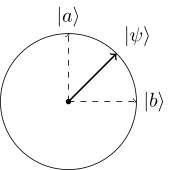
So there’s some experiment you can perform, and it has two possible answers: $\lvert a\rangle$ or $\lvert b\rangle$. These are the base states of the observable you are going to measure. Prior to you performing that experiment, the system was in some state $\lvert \psi\rangle$, and you (or someone else) may or may not know what that state was. If (unlike the above diagram) that prior state happened to be $\lvert a\rangle$:
\[\lvert \psi\rangle = \lvert a\rangle\]then your measurement will definitely have produced the answer $\lvert a\rangle$. But if the prior state (as shown above) is bang in the middle between the $\lvert a\rangle$ and $\lvert b\rangle$ base states, then you are equally likely to get either answer. Now, this is where people start talking about the system having been “in two states at once”. But it wasn’t. It was in one state, $\lvert \psi\rangle$, which we may, if we choose, build by adding two other vectors:
\[\lvert a\rangle + \lvert b\rangle\]with only a slight adjustment required because (by Pythagorus) this sum will give a vector of length $\sqrt{2}$, so we need to scale it down:
\[\lvert \psi\rangle = \frac{\lvert a\rangle + \lvert b\rangle}{\sqrt{2}}\]The only reason to describe it this way is because the thing we’re trying to measure can only produce those two possible results. If we were trying to measure some other binary attribute of the system, it could have measurement outcomes corresponding to two different state vectors, and one of them could be exactly equal to our system’s prior state $\lvert \psi\rangle$.
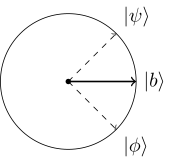
Viewed in this way, that prior state is not in a superposition at all. It is identical to one of the two base states. But now $\lvert b\rangle$ looks like a superposition. In other words, superposition is in the eye of the beholder. It’s a matter of perspective. If you’re measuring one specific observable then you are forced to adopt the appropriate perspective and then it will make sense to think of the prior state as some superposition of the base states of that observable.
This flexibility of perspective is something that is often glossed over, particularly in introductions to quantum computing, which treat a qubit as having two significant base states that we label with the interpretations $\lvert 0\rangle$ and $\lvert 1\rangle$, and we’re encouraged to think of any other states as superpositions. Two useful examples are:
\[\lvert \mathbb{+} \rangle = \frac{\lvert 0 \rangle + \lvert 1 \rangle}{\sqrt{2}}\]and:
\[\lvert \mathbb{-} \rangle = \frac{\lvert 0 \rangle - \lvert 1 \rangle}{\sqrt{2}}\]Here are all four states:
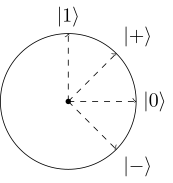
We could just as easily say:
\[\lvert 0 \rangle = \frac{\lvert \mathbb{+} \rangle + \lvert \mathbb{-} \rangle}{\sqrt{2}}\]and:
\[\lvert 1 \rangle = \frac{\lvert \mathbb{+} \rangle - \lvert \mathbb{-} \rangle}{\sqrt{2}}\]We’ve literally just switched the symbols. Neither basis has any special claim to reality. None of these vectors are intrinsically “superpositions.”
Not yet regretting the time you've spent here?
Keep reading: