Quantumania 4 - Enter Complex Numbers
One of the nice things about real vector spaces, at least in 1, 2 or 3 dimensions, is that they are easily visualised. Any higher than that and we hit a basic issue with our brain’s intuitive capabilites. The set of complex numbers $\mathbb{C}$ is also easy to visualise geometrically because it can be treated just like $\mathbb{R}^2$: a pair of real numbers $(a, b)$ maps to the complex number $a + bi$. Some of the associated structure is the same, too: addition, scaling by a real number.
What multiplication of two complex numbers? It seems strongly reminiscent of applying linear operators on $\mathbb{R}^2$. Given some complex number $x = c + di$ we can multiply it by another complex number $y = a + bi$ and so “move” $x$ to any point in the complex plane we wish:
\[yx = (a + bi)(c + di) = ac + bci + adi + bdi^2 = (ac - bd) + (bc - ad)i\]This sounds a lot like applying an operator on $R^2$, with $x$ as the input vector and $y$ acting as the operator. But it can’t have the full flexibility of a linear operator, because if we think of $y$ as a control panel, it only has two dials for us to adjust, instead of the full four of a matrix-defined operator on $R^2$. We can state the equivalent matrix for $y = a + bi$, and have it act on $x = c + di$:
\[\begin{bmatrix} a & -b \\ b & a \\ \end{bmatrix} \begin{bmatrix} c \\ d \\ \end{bmatrix} = \begin{bmatrix} ac - bd \\ bc + ad \\ \end{bmatrix}\]The resultant vector has the same coordinates we obtained from the complex multiplication. So evidently multiplying by $y$ is equivalent to a linear operation in $R^2$, because it’s expressible as a matrix, but it’s limited to just two ingredients: uniform scaling (that is, scaling by the same factor along all directions), and rotation.
Why is this important? Because QM makes use of complex vector spaces, that is, vector spaces where the scalars are complex numbers, and it is reasonable to ask why the formulation doesn’t simply use vector spaces with twice as many dimensions, replacing $\mathbb{C}^n$ with $\mathbb{R}^{2n}$, as this would describe the state of a system using exactly the same heap of real numbers. And the answer is that the latter would be too flexible when it comes to defining the allowed operations on the states. The use of complex numbers to tie together pairs of real numbers has a valuable constraining effect.
Complex Vector Spaces
If a vector space of dimension 4 or higher is impossible to visualise or grasp intuitively, then we have a problem. The most simple interesting state space in QM is $\mathbb{C}^2$, in which any vector has to be described by 4 numbers, just as in $\mathbb{R}^4$, so we are immediately faced with something we can’t even picture in our heads. It’s a two-dimensional space, but those dimensions are themselves two-dimensional.
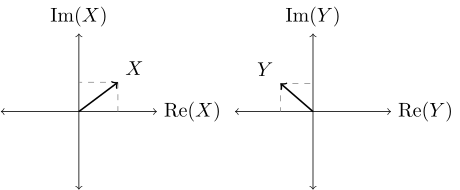
However, on the flat page we can draw two-dimensional slices of this space, and in a couple of ways. First, we can choose a basis $\lvert X\rangle$, $\lvert Y\rangle$ in the vector space, resolve vectors into coordinates in this basis, and draw two diagrams side by side, one for each coordinate:
And second, we can split into the real and imaginary halves:
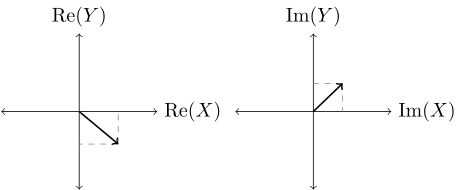
Both presentations convey the same information: four real numbers, just grouped into pairs differently. It’s tempting to think of these as somehow like looking at a structure from different directions. Given the first presentation, can we transform it to look like the second one by applying a linear operator? If we use a $4 \times 4$ matrix on the 4 real numbers, then yes. It’s a linear transformation at that level. But not if we use a $2 \times 2$ matrix of complex numbers operating on 2 complex coordinates, because it is impossible for us to perform the necessary switching around of real and imaginary parts. We are constrained by what complex multiplication can achieve. This follows from the fact that the complex $2 \times 2$ matrix is really only 8 adjustable dials (four complex numbers of two components each), where a real $4 \times 4$ matrix would provide 16 adjustable dials.
But in any case, both divided views are useful conceptually. The split between the complex coordinates is centred on the idea of a vector space in two dimensions, where there is some significance to how a certain basis divides up a vector into separate coordinates. The split between real and imaginary aspects is primarily useful because it throws up the idea that the imaginary side could happen to be the zero vector, with all the interesting stuff happening on the real side. This might mean that we could ignore the awkward fact of the space being complex in some situations and just picture it as a nice, simple real vector space in easily-pictured two dimensions. And this in fact proves to be the case at least to some extent, allowing us to walk through simple scenarios with qubits visually (and this is the reason my earlier diagrams have been valid.)
Unfortunately I don’t think there is any helpful unified way to try to visualise a complex vector space as arrows, or arrows that can be twisted, or arrows that have a little clockface on the end that tells you their phase, and so. The role of arrows is to allow us to describe vector addition very simply by placing two or more arrows tip to tail and finding the resultant as the new arrow that connects the tail of the first to the tip of the last. This visual analogy is useless with a complex vector space. To find the actual resultant vector, we can’t really do much better than to pick a basis, drop to a coordinate description, add the coordinates (which each have two real number parts that have to be added as if they were separate sub-coordinates) and now we have a coordinate description of the resultant. Changing the relative phases of the input vectors can alter the alignment and magnitude of the resultant.
Not yet regretting the time you've spent here?
Keep reading: