Quantumania 6 - That Darn Cat
I hate Schrödinger’s cat. But it’s time to talk about the measurement problem. Last time we discovered that the spatial direction “left” is a linear composition of the directions “up” and “down”. What precisely we mean by this is that the state vector (in abstract complex state space) representing the spin state of an isolated electron has an exact one-to-one relationship with a direction in physical space.
Do we mean that the electron’s spin orientation “points” in a particular direction? Well, yes and no. We have to be careful because there is a fundamental limit on what exactly we can measure about it. First we have to choose an axis in space along which to measure. Then we make the measurement, and the answer is essentially binary. If we measure along the  (up/down) axis, we get exactly one of the two possible answers for that axis: up or down. This doesn’t tell us that the electron’s spin was aligned along that axis before we took the measurement, but it does mean that it has become aligned with that axis, due to us making the measurement.
It would seem to follow that if we encounter a strange electron, whose provenance is unaccounted for, we could think of it as having previously been measured along some axis, by someone else, and thus its spin is aligned with whatever axis the electron’s previous owner chose to measure along. Now, it turns out that this isn’t true, due to an actually flabbergasting discovery about the nature of QM. But for now, pretend I didn’t say that. Assume that every electron we might encounter is an isolated quantum system with its own private state vector, and when it reaches us, it’s in some post-measurement state that corresponds to a measured direction of which we have no knowledge.
The question is, what happens if we choose to measure the mystery electron’s spin along the wrong axis? We said above that, post-measurement, it does mean that it has become aligned with that axis, due to us making the measurement. So we can think of the spin snapping from whatever unknown alignment it had into perfect alignment with the axis we chose to measure along. This means it has to somehow choose from the two available directions along our chosen axis. How does it make this choice? This is an open question. It’s going to turn out that it might not make the choice at all, but again, we’ll defer that discussion for now.
The one thing that is beyond doubt is that we will get a specific answer, and any subsequent behaviour of the electron that we can detect will be in accord with that answer. To be precise: if we measure a second time along the same axis, we’ll get the same result. But if we adjust the angle for the second measurement, it is as if nature flips a coin to decide which way the electron’s spin will now point along our chosen axis of measurement. But not necessarily a fair coin! On each measurement, the odds of the two possible outcomes depend only on the angle between this measurement’s possible outcomes and the direction found by the prior measurement. We can calculate those odds (although checking that we’ve done this right requires repeatedly performing the same experiment on many electrons.)
Let’s suppose that we’re going to measure along the (up/down) axis, and the electron’s previous owner, unbeknownst to us, measured it along the  (front/back) axis and got the result: front. We can express that direction’s state in terms of our measurement basis:
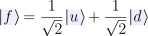
So both components of the vector have the coordinate  . They’re perfectly balanced, as the Mad Titan would say. No surprises that in this case, the measurement does in fact behave like a fair coin, and chooses to snap the electron’s spin to either up or down with equal probability.
But we can set the coordinates to something unbalanced such as  instead. We know that if you square the modulus of each coordinate, they must sum to
  , in order for it to be a unit vector, and I’ve chosen those numbers so that they about square to
  and
and  respectively. The Born rule is that the squared modulus of the coordinate by which we scale one of the base components is the probability of that outcome being measured. So we predict a probability of measuring up, and of measuring down. In general, the closer we are to measuring along the correct axis (the one measured along by the electron’s previous owner), the more biased the measurement outcome, and it favours the result that has the smallest angular separation from the result obtained by the previous owner.
We can translate this into angles in physical space quite straightforwardly. Recall the Bloch sphere formula for building a state vector for any direction in space:

The previous owner’s measurement left the electron spin in state  . The probability of obtaining the result up,
  , is given by the modulus-squared of the coordinate for
  , which is described in terms of the angle
  by which the previous owner’s measurement outcome was misaligned with our up-direction:
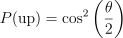
If the previous owner measured the direction to be front,  , so the probability of us measuring up is
  which is
  , just as we’d expect.
If the angle between our up direction and the prior measured direction is only  , that’s about
  radians, we are very likely to measure up, with a probability of at least 99.992%.
And by the symmetry of the situation (we could pick any direction to call “up”), this is true for any disagreement in directions to be measured along. Also the second term gives us the probability of down, and its coordinate includes the phase factor dependent on  , but it’s always a unit factor, so it has no effect on the modulus of the coordinate, and thus no effect on the probability.
So if it’s this simple, what exactly is this famous measurement problem? It has to do with something we haven’t reached yet, which is that QM tells us how to construct a model of how the state vector of a system changes as time passes. There are no exceptions or special cases in how this works. It’s a completely universal pattern. Also, the measuring equipment is just more stuff in the universe, as are we ourselves, and all the stuff in the universe is described by QM. The problem is, there is nothing in this approach that says that there are certain special kinds of interactions in which state vectors discontinuously snap into alignment with the direction of something else. And yet the only thing we can usefully get from the model is the probability distribution over measurement outcomes that involve exactly that kind of supposed discontinuous snapping into alignment. So it’s a theory for generating probabilities for things it apparently says will never happen.
We’ll come back to this.
Not yet regretting the time you've spent here?
Keep reading: