Quantumania 8 - Too Much for Einstein
The combined two-qubit states we discovered yesterday, which are just products of the individual qubit states, do not cover every possible state that could exist in the combined system. We can see why if we write the  -vector as a
  matrix:

Because of how we constructed it, multiplying out  and
and  , the first row is scaled by
  , and the second row is scaled by
  . They are like colinear vectors: they only differ by a scaling factor. Likewise, the first column is scaled by
  , and the second column is scaled by
  . So the columns are colinear too. It’s very easy to make a matrix that doesn’t conform to this pattern: make a slight adjustment to one of the elements and you’ll break the pattern completely.
The states that do conform to this pattern have the property that we can factorise them, taking them back to the separate qubit physical states that we multiplied out to produce the joint state. This does not exactly mean that we can recover the original coordinates, mind you. Suppose the  are real numbers, and either all of them are positive or all are negative. How could we tell which sign they have, given that all we have in the combined coordinates are products of them?
And of course, they are in fact allowed to be any complex number. The phase factors that twist by the same angle in opposite directions always multiply to make one:

If  , you can twist either way to arrive at the same value,
  , and so the fact that
  is just a special case of the above fact. So if we scale the input vectors by opposite-twisted phase factors and then make their product, we’ll get the same coordinates:

The opposite phase twists cancel out. So from the coordinates of the joint state, we can recover the coordinates of two separate qubit vectors, but we can’t get the phase right. But we know that an overall phase makes no difference to the physical state being described, which is why I was able to make the (carefully worded) claim above that factorising, where it is possible, takes us back to the separate qubit physical states. Just not necessarily exactly the same coordinates.
So if we start with one of these product states, and then tweak one of the coordinates in its 4-vector (and renormalise), we have a vector that cannot be factored into two separate qubit states. What are we to make of this physically? We have to accept that the individual qubits don’t have a state vector of their own. How ridiculous is that? Remember previously when I said:
It would seem to follow that if we encounter a strange electron, whose provenance is unaccounted for, we could think of it as having previously been measured along some axis, by someone else, and thus its spin is aligned with whatever axis the electron’s previous owner chose to measure along. Now, it turns out that this isn’t true, due to an actually flabbergasting discovery about the nature of QM. But for now, pretend I didn’t say that.
Well, now the time for pretending is over. A strange electron (read: qubit) you encounter might not have a state vector of its own, prepared when it was individually measured along some axis. It might be part of a larger system of two or more qubits, which have a joint state that is not a simple product state, and so cannot be factored into separate qubit state vectors.
But such a state can always be expressed as a sum of simple product states. We know this because our basis states in the combined state space are product states, and they are the one-hot 4-vectors in that basis. When you scale a one-hot vector by some factor  , you simply replace the
  with . Do this with all four one-hot vectors, using a different scalar for each, and then add them, and you’ve made whatever 4-vector you want:
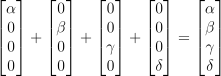
So every state vector for the two-qubit system can be expressed in the form:

By the Born rule we can square the modulus of these coordinates to get the probability of the corresponding measurement outcome. The total probability must be one, which is just the unit vector condition:

So we can interpret any states of a two-qubit system as telling us the probability that we’ll get each of the 4 possible measurement outcomes. One of the states we considered yesterday was:
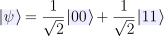
We can exercise our ability to juggle with tensors by seeing if we can write this state in another basis entirely. A while back we figured out how the basis vectors  and
and  could be recast as linear combinations in another basis:
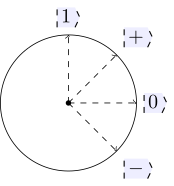

So to get an expression for  we can just multiply out:

And likewise for  :
:

The state we want to write involves the sum of these, and the  and
and  terms are going to cancel out, while the other two reinforce, leaving:

And so:

The significance of this is that the state where the qubits are constrained to the same value in the  basis (
 ) is physically the exact same state where they are constrained to the same value in the
  basis (
 ). We could measure the first qubit along either of these directions (which are orthogonal in physical space) and we’d know the value of the other qubit in that same basis automatically.
Von Neumann worked out the formal mathematics for all this in 1932, and by that point, Einstein was way past having his gast flabbered. He coauthored the EPR paper (1935) spelling out the implications in vivid terms. Actually he thought he’d figured out that QM was an incomplete theory, as he put it. His reasoning (translated into modern terminology) was as follows:
-
QM says two qubits can be in a combined state that can’t be factored, so the individual qubits don’t have a separate state each of their own.
-
If the qubits are the correlated state we just walked through, we could choose freely to measure the first qubit along either the
or axes, and whichever result we’d get, we’d be able to predict the second qubit’s measurement outcome along the same choice of axis: it would be the same. -
The act of measuring the first qubit can’t change anything about the second qubit (they could be light-years apart.)
-
If we know the state of the second qubit without having to interact with it at all, it must have already been somehow “storing” pre-configured responses for both the
and axes, as must the first qubit, the whole time. There was never any uncertainty. -
Therefore QM’s single state vector for the two-qubit system does not describe the actual state of the qubits.
In response to this, it was Schrödinger who gave this phenomenon its name: entanglement.
The problem is, the argument contains a flawed assumption, and experiments have proven it to be false.
Not yet regretting the time you've spent here?
Keep reading: