Quantumania 9 - Farewell to Locality
Despite our aim to talk like qubit enthusiasts, yesterday as we wrote down expressions involving adding and subtracting vectors labelled with the symbols for addition and subtraction, things got unnecessarily garbled. To limit that for now, because today’s argument is going to be confusing enough, I’m going to retreat to using physical space labels. So, the state vectors representing the up, $\vert u\rangle$, and down, $\vert d\rangle$, directions (the Z-axis) can be scaled and summed to make state vectors representing the front, $\vert f\rangle$, and back, $\vert b\rangle$, directions (the X-axis):
\[\vert f\rangle = \frac{\vert u\rangle + \vert d\rangle}{\sqrt{2}} \quad \quad \vert b\rangle = \frac{\vert u\rangle - \vert d\rangle}{\sqrt{2}}\]and vice versa:
\[\vert u\rangle = \frac{\vert f\rangle + \vert b\rangle}{\sqrt{2}} \quad \quad \vert d\rangle = \frac{\vert f\rangle - \vert b\rangle}{\sqrt{2}}\]And this is just a relabelling of our favourite diagram:
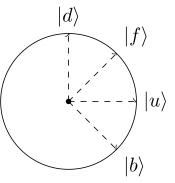
And we could introduce the Y direction and show how it too is a basis for representing the other two, because space has rotational symmetry, but we aren’t going to need it today. Also, we can still call such a system a qubit, so we shall.
We’ve seen how we can represent a two-qubit system by a single combined state space in which we need 4 basis vectors to serve as ingredients for building any possible vector, allowing us to choose a basis and then describe some vector in that basis. Our story today starts with imagining a two-qubit system that is in a state such that, if you measured both qubits along Z, the one combination of results you won’t ever get is both up, $\vert uu \rangle$. The other three combinations are equally likely:
\[\vert \psi\rangle = \frac{\vert du \rangle + \vert ud \rangle - \vert dd \rangle}{\sqrt{3}}\](Why does $\vert dd \rangle$ have a minus sign? Well, why not? Any of the terms could be positive, negative, or could have an $i$ in front, or any unit complex value, without altering the predicted probability for that term’s basis state to be measured.)
Three equally likely outcomes must each have probability $1/3$, so their coordinates must produce that when squared, hence the overall factor of $1/\sqrt{3}$. But I’m not going to worry too much about normalisation, because I don’t care about the exact probabilities of outcomes, only whether or not they are possible at all, meaning that they have any non-zero probability. Any non-zero vector belongs on some ray, and rays are what stand for physical states. So instead of using $=$ I’ll use $\propto$ to mean equivalence, where I’m ignoring overall scaling factors:
\[\vert \psi\rangle \propto \vert du \rangle + \vert ud \rangle - \vert dd \rangle\]Now suppose the qubits have been separated a long way apart and those popular thought-experiment participants Alice and Bob have got one each. They each have a free choice of whether they measure their qubit along the Z or X axis. The above expression tells us what happens if they both choose Z because it’s written in that basis.
By substituting our expressions for $\vert u\rangle$ and $\vert d\rangle$ in terms of $\vert f\rangle$ and $\vert b\rangle$, we can describe the same state in the X basis, and thus get probabilities for what might happen if Alice and Bob both choose to measure along X. We can start by multiplying out our three active ingredients:
\[\vert du \rangle \propto \left[\vert f \rangle - \vert b \rangle \right] \left[ \vert f \rangle + \vert b \rangle \right] = \vert ff \rangle + \vert fb \rangle - \vert bf \rangle - \vert bb \rangle\] \[\vert ud \rangle \propto \left[\vert f \rangle + \vert b \rangle \right] \left[\vert f \rangle - \vert b \rangle \right] = \vert ff \rangle - \vert fb \rangle + \vert bf \rangle - \vert bb \rangle\] \[\vert dd \rangle \propto \left[\vert f \rangle - \vert b \rangle \right] \left[\vert f \rangle - \vert b \rangle \right] = \vert ff \rangle - \vert fb \rangle - \vert bf \rangle + \vert bb \rangle\]And so (being careful with the fact that we’re subtracting $\vert dd \rangle$):
\[\vert du \rangle + \vert ud \rangle - \vert dd \rangle \propto \vert ff \rangle + \vert fb \rangle + \vert bf \rangle - 3\vert bb \rangle\]So in the X basis, every combination of outcomes has a non-zero probability. We’ve found that if Alice and Bob both choose to measure along X, there is no restriction on what results they might get, although there is a strong bias toward them both obtaining back.
What about when they each choose a different axis? So far we’ve only done full “basis conversions” so our expressions end up being expressed entirely in one basis, which may have created a misleading impression that this is some kind of rule we have to obey. Or that tensor products must be between orthogonal unit vectors from the same basis. These would be completely fictitious rules. By $\vert \psi \phi \rangle$ we mean $\vert \psi \rangle \otimes \vert \phi \rangle$, and they can be any two vectors, and they don’t even have to be from the same vector space, let alone necessarily defined in some compatible basis. In the way we’re using the tensor product, the two sides are always different vector spaces! The first qubit is described by vectors that do not describe the second qubit at all.
So now we’re going to suppose that Alice sticks with Z and Bob goes with X. We only need to substitute into the second slot of the tensor products for our three ingredients:
\[\vert du \rangle \propto \vert d \rangle \left[ \vert f \rangle + \vert b \rangle \right] = \vert df \rangle + \vert db \rangle\] \[\vert ud \rangle \propto \vert u \rangle \left[\vert f \rangle - \vert b \rangle \right] = \vert uf \rangle - \vert ub \rangle\] \[\vert dd \rangle \propto \vert d \rangle \left[\vert f \rangle - \vert b \rangle \right] = \vert df \rangle - \vert db \rangle\]And so:
\[\vert du \rangle + \vert ud \rangle - \vert dd \rangle \propto 2\vert db \rangle + \vert uf \rangle - \vert ub \rangle\]As before there are four conceivable outcomes, but there’s no term for $\vert df \rangle$, meaning that this outcome is impossible, but all three other combinations can happen.
Something symmetrical ought to happen if they make the opposite choices of basis, but let’s check to be sure:
\[\vert du \rangle \propto \left[ \vert f \rangle - \vert b \rangle \right] \vert u \rangle = \vert fu \rangle - \vert bu \rangle\] \[\vert ud \rangle \propto \left[\vert f \rangle + \vert b \rangle \right] \vert d \rangle = \vert fd \rangle + \vert bd \rangle\] \[\vert dd \rangle \propto \left[\vert f \rangle - \vert b \rangle \right] \vert d \rangle = \vert fd \rangle - \vert bd \rangle\] \[\vert du \rangle + \vert ud \rangle - \vert dd \rangle \propto \vert fu \rangle - \vert bu \rangle + 2\vert bd \rangle\]This time there’s no $\vert fd \rangle$ term, so that is precisely symmetrical. From these last two meanderings, we’ve found that when they make the opposite decision on what axis to measure along, if the one measuring along X finds the result is front, the other will not get the result down.
And now Einstein’s position is in real trouble. He insists that two qubits, possibly on different planets, must function like independent machines. We feed a bit of information into them (choice of axis to measure along) and they output a bit of information (which way along that axis). They must do this entirely without any connection between the two qubits, because, as Einstein’s entire programme of physics insists, that’s not how the universe works. Information originating at one place has to travel at no faster than the speed of light in order to interfere with what happens at other places. Separate locations are not linked by invisible wires that can stretch over any distance. The very idea is ridiculous, he says.
Why is he in trouble? Einstein regards a qubit as essentially just a function $Q \colon \mathbb{B} \to \mathbb{B}$ that maps a bit to a bit. Each just needs to hold a prepared answer for the two possible input bits it might receive, e.g.
- $Z \to \vert d \rangle$ - if they measure along $Z$, my answer will be down
- $X \to \vert b \rangle$ - if they measure along $X$, my answer will be back
One qubit certainly cannot change its effective output based on the input or output of another qubit. But a qubit pair can of course have been produced, in one place, by a not entirely predictable process, that prepared each qubit’s outputs in a correlated way, before they were separated. So for example, the first rule, that $\vert uu \rangle$ is not possible, is easily arranged by such a preparation process, by ensuring that it never prepares both qubits in the same pair with the rule $Z \to \vert u \rangle$.
If Alice’s qubit has the rule $X \to \vert f \rangle$, Bob’s qubit must be prepared with $Z \to \vert u \rangle$, because $\vert fd \rangle$ is disallowed. And we found this situation to be symmetrical under an exchange of Alice and Bob.
But Alice and Bob might both choose to measure on axis X, which they are free to do, and there’s nothing saying they can’t get $\vert ff \rangle$. But we just noted that if one qubit is configured $X \to \vert f \rangle$ then the other must have $Z \to \vert u \rangle$. So if both qubits have been prepared with $X \to \vert f \rangle$, they both force the other to have $Z \to \vert u \rangle$. That is, it could be that both qubits have these rules:
- $Z \to \vert u \rangle$
- $X \to \vert f \rangle$
But that means if Alice and Bob both happened to measure on Z on two qubits prepared in that way, the result would be $\vert uu \rangle$. This is the problem. Referring back to how we specified the QM state:
\[\vert \psi\rangle \propto \vert du \rangle + \vert ud \rangle - \vert dd \rangle\]There’s no $\vert uu \rangle$ term in there. That never happens. So to recap: QM says $\vert ff \rangle$ happens sometimes, with a calculable probability, and such qubit pairs, if they are entirely separate disconnected bit-to-bit functions, must be prepared in such a way that the pair could produce $\vert uu \rangle$, which is a result entirely disallowed by QM. The only way for this to be consistent is for the probability of $\vert ff \rangle$ to drop to zero, instead of the “sometimes” predicted by QM. The process that prepares qubit pairs, whatever it is, must never allow $\vert ff \rangle$, because that is the same as allowing $\vert uu \rangle$, which is banned.
This argument utilising $\vert du \rangle + \vert ud \rangle - \vert dd \rangle$ was only described for the first time in 1993 by Lucien Hardy, but has since been tested experimentally many times, and QM always wins. The result $\vert ff \rangle$ does happen sometimes, with the probability predicted by QM.
So if it is not the case that these qubits are pairs of independent functions $Q \colon \mathbb{B} \to \mathbb{B}$, then what are they?
There are several options, none of which can persuade everyone, and the debate is frustratingly philosophical and lacking in experimental support for any one position over another, with the curious result that opinions are held even more firmly.
We could think of the qubits as a single function that maps pairs of bits to pairs of bits:
\[P \colon (\mathbb{B} \times \mathbb{B}) \to (\mathbb{B} \times \mathbb{B})\]The one function can “see” both the inputs so as to determine what the outputs should be. Rather than each qubit storing two rules of its own, any given pair of qubits has a list of four rules for what outputs they give based on the combination of measurement axes chosen by Alice and Bob.
Abstractly speaking, in terms of how the choices made by the two experimenters produce a result, this is exactly what we’ve found to be the case, though this doesn’t immediately prove a deterministic mechanism. But one of the options is to think of a physical connection between the qubits that works in this way. This is known as “giving up locality”, or “non-localism.” There is even a conjecture (ER = EPR, Maldecena and Susskind, 2013) suggesting that another Einstein paper from 1935 might have the answer. General Relativity allows for the existence of wormholes (sometimes called Einstein-Rosen bridges after the paper’s authors) connecting distant points in spacetime, and it was shown that two maximally entangled black holes have the same mathematical description as two black holes connected by a wormhole.
Another option, “superdeterminism”, is that Einstein is right about the qubits being independent bit-to-bit functions, but whenever the universe prepares both with $X \to \vert f \rangle$ and thus $Z \to \vert u \rangle$, the universe also “prepares” Alice and Bob so that they won’t both choose Z to measure along, ensuring $\vert uu \rangle$ is never measured. That is, it rigs the brains of humans (presumably by plotting out their life stories in minute detail) so they never want to perform certain experiments under particular circumstances. One way to arrange this without having to plan out the history of the universe so meticulously would be allow cause and effect to travel backwards through time: because Alice and Bob are now choosing to measure along Z, therefore the qubits were prepared earlier in a state other than $\vert uu \rangle$. Both of these seem to introduce something far more ridiculous than the idea that two distant things can behave in a way that turns out to be correlated.
Another option, known as “Copenhagen” for historical reasons, is not very clearly defined, but can be roughly summarised as: “Why do you think nature owes you an answer to this question? Forget it, Jake - it’s Quantumtown.”
Not yet regretting the time you've spent here?
Keep reading: